
The Company Holiday Party Timeline That Actually Works
Quick Answer
Schedule the main entertainment for after dinner, at around 8:00 PM. At a company holiday party a 45 minute after dinner show lands best, because guests are already seated facing the same direction, the room has warmed up over a meal, and nobody has left yet. Use the cocktail hour for strolling magic instead, and hold the dancing until after the show.
Key Takeaways
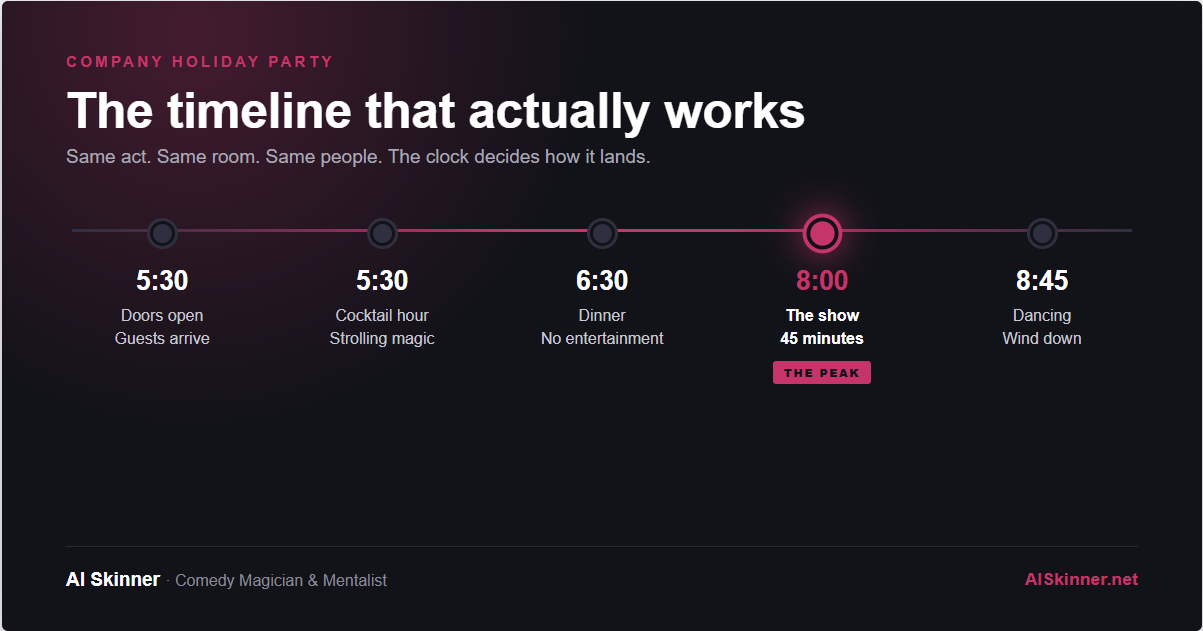
- A company holiday party timeline that works: doors at 5:30, cocktail hour 5:30 to 6:30, dinner at 6:30, the show at 8:00, dancing from 8:45.
- An after dinner show runs 45 minutes. An extended show runs one hour.
- Strolling magic is booked by the hour, one hour or two, with a one hour minimum.
- The show belongs after dinner because the room is already seated, already warmed up, and still full.
- For a dinner event, your entertainer should be on site one hour before the doors open, not one hour before the show starts.
Most holiday party planning goes into the venue, the menu and the budget. Then the entertainment gets slotted into whatever gap is left on the schedule.
That gap is usually the thing that decides how the night goes.
After fifteen years and more than a hundred corporate events, I can tell you that the same act, in the same room, for the same people, lands completely differently at 6:45 than it does at 8:15. Here is the shape of an evening that works, and why each piece sits where it does.
The Timeline That Works
5:30 — Doors open. Guests arrive over about forty minutes. Nobody is ready for anything yet. They are finding the bar, finding their table, and finding out who else came.
5:30 to 6:30 — Cocktail hour. This is the window for strolling magic, moving from group to group. It does a specific job: it breaks up the clumps of people who already know each other. By the time dinner is called, the room has mixed.
6:30 — Dinner. No entertainment. People are eating and talking, and anything competing with that loses.
8:00 — The show. Dessert is out, drinks have been refreshed, and everyone is already sitting down facing the same direction. This is the best forty five minutes of the night and it is not close.
8:45 — Dancing, or the bar, or home. The evening has peaked and now it can relax.
Why the Show Goes After Dinner, Not Before
Three reasons, and they all come down to the same thing.
Everyone is already seated. No one has to be gathered, hushed or moved. The hardest part of any show is getting a room's attention, and dinner does it for you.
The room has warmed up. A crowd that has eaten together and had a drink laughs about twice as easily as a crowd that walked in twenty minutes ago.
Nobody has left yet. Put the entertainment at 9:30 and you are performing for whoever is still standing.
Sound familiar?
The entertainment is called at 9:30. A third of the room has already slipped out to beat the traffic, another third is deep in conversation at the bar, and the people who stayed are watching a show they can barely hear over the music nobody thought to turn down. The act was fine. The slot was wrong.
The Three Mistakes I See Most
Watch for these
1
Starting the entertainment during arrivals
Half the guests are still parking. The half who are there watch a show the other half will only hear about secondhand.
2
A dance floor between the audience and the act
The front tables end up thirty feet back. If there is dancing later, ask the venue to hold the floor until after the show, or bring the tables in close.
3
Leaving it until after the dancing starts
Once people are up and moving, the evening has changed shape. You cannot put it back.
"The same act, in the same room, for the same people, lands completely differently at 6:45 than it does at 8:15."
How Long Each Piece Actually Takes
Planners ask me this constantly, so here are real numbers.
An after dinner show is 45 minutes. That is the standard, and it is the right length. An extended show is one hour. Strolling magic is booked by the hour, one hour or two, matched to how long your reception runs. Anything under an hour still bills as an hour.
If you are weighing one against the other, it is worth understanding the difference between strolling magic and a stage show before you build your schedule around either one.
The Question Worth Asking Any Entertainer
Not "what time do you want to go on?" but "what time do you need to be here?"
For a show I am on site an hour before. For a dinner event I am there an hour before the doors open, not an hour before I go on, so that I am never setting up while your guests are arriving.
That distinction matters more than it sounds. It is the difference between a performer who appears out of nowhere and one your guests watch unload a case.
Build the Night, Then Book It
A good evening builds. Arrival, food, the peak, then the wind down. Entertainment placed at the peak makes the whole night feel designed rather than assembled.
Two things worth reading next. The room you have chosen shapes all of this more than most planners expect, and the good acts are booked far earlier than you think.
And if you are still deciding what to book, start there before you start on the clock.
Planning your night?
Let's talk through your run of show
I have spent fifteen years and more than a hundred corporate events learning where the entertainment belongs. Happy to help you think it through, whether or not you book me. See more on corporate holiday party entertainment.
Frequently Asked Questions
What time should entertainment start at a company holiday party?
Around 8:00 PM, after dinner and dessert. Guests are already seated and facing the same direction, the room has warmed up over a meal, and nobody has started to leave. On a 5:30 start, that puts the show roughly two and a half hours into the evening.
How long is a corporate magic show?
An after dinner show runs 45 minutes. An extended show runs one hour. Strolling magic is booked by the hour instead, either one hour or two, with a one hour minimum.
Should the magician perform during cocktail hour or after dinner?
Both work, and they do different jobs. Strolling magic during the cocktail hour mixes the room and breaks up the groups who already know each other. A seated show after dinner is the peak of the evening. Many companies book both.
How early does the entertainer need to arrive?
For a dinner event, one hour before the doors open, not one hour before the show. That way setup is finished before the first guest walks in. For strolling only, about thirty minutes before the reception starts.
Where should the dance floor go if there is a show?
Not between the audience and the performer. An open dance floor in front of the stage pushes the closest tables thirty feet back. Either hold the floor until after the show, or bring the tables in close and open it afterward.